
Buying Guides
Custom EVA Foam Packaging Inserts: What to Specify Before You Order
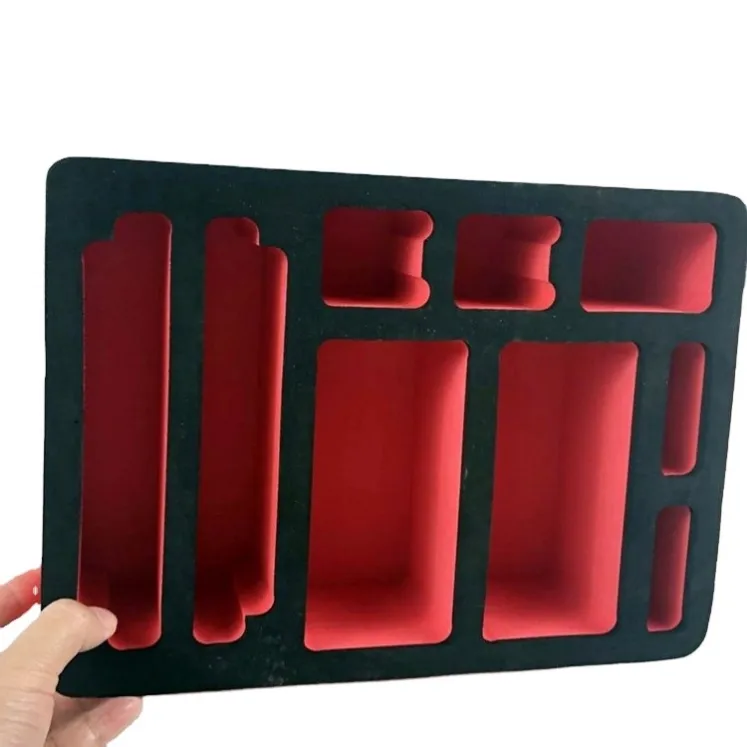
A foam insert either holds the product still or it doesn't. There isn't much middle ground. A cavity a millimetre too loose lets a lens rattle against the box wall; a foam too soft lets a corner punch through on the second drop. Most of the inserts we make succeed or fail on details decided before the first sample is cut. The eight points below are the checklist we work from when a customer sends in a new packaging project. Answer them, and we can quote within 24 hours and cut a sample within 7 days.
Work through them in order — each one feeds the next.
1. Start with the product, not the foam
The foam is the answer; the product is the question. Before density or thickness, we need the product's weight, its outside dimensions, and where it breaks. A glass bottle breaks at the neck. A circuit board breaks at the connector pins. A lens scratches anywhere it touches. Tell us the fragile points, how the parcel travels — courier satchel, export carton, pallet — and what a bad day in transit looks like for your shipment. A 200-gram board and a 2-kilo bottle can share the same box size and still need completely different inserts.
2. Density: 85–190 kg/m³
Density is the single biggest lever on protection. Our standard EVA sheet runs 85 to 190 kg/m³. The lower end, around 85–120, suits light items and cosmetic protection — it cuts cleanly and keeps the insert light. Mid-range densities cover most electronics and glassware. At 150–190 the foam starts carrying load: tool cases, inserts that get handled daily, products that sit in the same tray for years. Density also decides how the cavity cuts. Too soft and the edges tear; too firm and thin walls can crack on the die. If you don't know where to start, send the product weight and we'll suggest a density — but the weight is what makes the suggestion worth anything.
3. Thickness and cavity depth
Sheet runs 2 to 90 mm thick. Past 90 mm we laminate layers, which is also how dual-density inserts are built — a firm base with a softer top layer that grips the product. The cavity should leave solid foam under the deepest point of the product. A useful rule of thumb: at least 10 mm of foam under anything fragile, more if the parcel travels by courier rather than pallet. And measure the cavity against the product, not the drawing of the product. A millimetre of optimism in a drawing becomes a loose fit on the bench.
4. Closed-cell, as a rule
For export packaging, closed-cell EVA is the default. It doesn't absorb water, it resists dust, and it springs back after compression. A container crossing the equator in July is humid; an insert that soaks up moisture gets heavier, softer, and eventually smells. Open-cell foam has its uses — extra softness, airflow — but packaging is rarely one of them. If a supplier offers open-cell for a shipping insert, ask why.
5. Colour is functional, not decorative
Fifteen standard colours, Pantone matching on request. Black is the workhorse for electronics and tools. Two-colour inserts — a black base with a red or blue cavity layer — do a job plain black can't: a missing part shows up at a glance on a packing line or in a tool check. Colour also turns a plain carton into a presentation case when the customer opens it. Say the colour in the order; "standard black" and "Pantone 186C" are not the same conversation.
6. Lamination and layers
One layer is fine for a simple tray. Two layers open up real options: a firm base that holds shape, a soft top that grips, a coloured cavity layer that shows empty slots. Lamination is also how we build inserts thicker than 90 mm. Tell us what each layer has to do and we'll build the stack. A laminated insert costs more than a single sheet, but it replaces a separate lid pad and a base pad, so count the whole pack, not the single piece.
7. Adhesive backing and fixing
An insert that slides around inside its box protects nothing. Pressure-sensitive adhesive (PSA) backing holds the insert to the case or carton. For reusable cases, a plain insert with a finger cut-out works better — the user lifts it out, the foam stays put by fit alone. Say which one you need. If the insert goes into a flight case that gets opened a hundred times, fit beats glue.
8. Drawings, tolerances, and the box itself
Send a drawing, a DXF file, or the product itself — in that order of preference. State the tolerance you need rather than assuming one; die-cutting holds tight tolerances, but "tight" means different things to different buyers. And send the inside dimensions of the box, not just the product. The most common sizing mistake we see is an insert measured to the product and dropped into a box it doesn't fill. Foam protects by filling space. Measure the space.
Three mistakes we see again and again
First, choosing density by price: the cheapest foam that "looks the same" compresses flat somewhere between Ningbo and the customer's warehouse, and the saving disappears into the first damaged shipment. Second, sending product dimensions without the box: the insert fits the product and floats in the carton. Third, forgetting the unboxing: an insert that protects perfectly but needs a screwdriver to lift the product out gets cut apart on the customer's bench — and the next order comes back as a complaint about the packaging, not praise for it.
How ordering works with us
Send the drawing or the product, the quantities, and the destination country if compliance matters. We quote within 24 hours. Samples ship within 7 days; once you approve the sample, bulk production runs within 15 days, with the exact schedule confirmed per order. Minimum order is 100 pieces per colour. Trade terms are FOB Ningbo or Shanghai, EXW, CIF or CFR, and we take T/T, L/C, D/A, D/P or O/A. The factory holds SGS, PAHS and ISO 9001, and REACH, RoHS and EN71 testing is available as SGS special tests on request; the BV factory audit record is MIC-ASR2431136. The foam is made in our own plant — 10,000 m², three foaming lines, making EVA foam since 2003 — so a sample is cut from production material, not a lab swatch.
Good packaging inserts are specified, not guessed. Send the drawing, the product weight, and the box it travels in, and we'll tell you what we would cut and why before you commit to a sample. That conversation is the whole point of the sample stage — better to argue about density now than about damage claims later.