
Buying Guides
Closed-Cell vs Open-Cell EVA Foam: Which One Does Your Product Actually Need?
Closed-cell EVA keeps water out; open-cell lets air and sound through. Same resin, different structure — and picking the wrong one is the most common spec mistake we see.
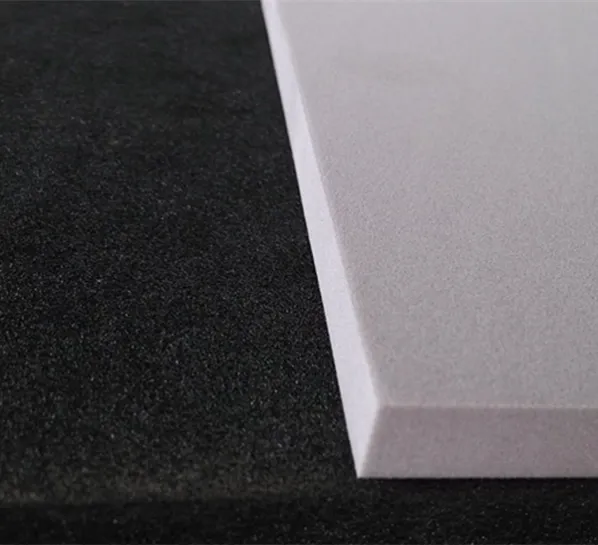
Ask three suppliers for a quote on "EVA foam sheet" and you can get three different materials back — all of them correctly labelled EVA. The difference that causes most of the trouble is the one buyers ask about least: whether the cells are closed or open.
It is the same resin either way. The difference is structure. In closed-cell EVA, every tiny bubble is sealed off from its neighbours, like a honeycomb with the doors shut. In open-cell EVA, the bubbles connect to each other, like a sponge. That one difference decides whether a sheet keeps water out or drinks it in, whether it seals a gap or breathes through it, and whether it is still doing its job a year later or has gone soft in a month.
The ten-second test
You can tell them apart without any lab equipment. Put a few drops of water on the surface. On closed-cell foam the water sits there in beads. On open-cell it disappears into the sheet within seconds. Press the sheet with a thumb and let go: closed-cell springs back and keeps its shape; open-cell feels softer and slower to recover, and it stays slightly damp where the water went in.
That is the whole story in miniature. Everything else follows from it.
Side by side
Our closed-cell EVA foam sheet runs 30–120 kg/m³, 2–90 mm thick, in 2000×1000 mm sheets with custom colours on request. The sealed cells keep out water, oil and chemicals, so the sheet stays light and firm, holds its shape under pressure, and cuts and glues cleanly. It is the workhorse grade: packaging, gaskets, shoe parts, protective padding.
Our open-cell EVA foam sheet runs lighter, 25–60 kg/m³, 2–60 mm thick, same sheet size. It is soft, breathable and flexible, and it absorbs water and sound instead of blocking them. That sounds like a drawback until you need exactly that — a sponge, a filter, acoustic padding, a soft layer that lets air through.
Neither is "better". They solve opposite problems, and a sheet that is perfect for one job fails the other.
Where each one earns its keep
Closed-cell is the default for anything that meets water, weather or repeated compression. Die-cut packaging inserts: the insert protects the product and does not soak up warehouse humidity on the way. EVA gaskets: the foam compresses into a gap and seals out water, dust and vibration — our gaskets run 2–20 mm in custom die-cut shapes. Shoe parts, floor mats, marine decking, yoga mats, cosplay sheet that gets heat-formed at 110–140°C: all closed-cell, because all of them need to stay dry and keep their shape.
Open-cell earns its keep where air, sound or liquid has to move through the foam. Filters and sponges are the obvious ones. Acoustic padding inside a case or a room lining: the connected cells trap sound instead of bouncing it back. Soft craft padding and lining layers where the foam needs to breathe against skin or fabric. If your product's job is to absorb — water, sound, impact over a soft landing — open-cell is usually the starting point.
Three mistakes we see again and again
First, ordering open-cell for anything that gets wet. An outdoor cushion, a boat fitting, a washable mat: open-cell will hold the water, gain weight, and grow mould in storage. If the product lives outdoors or gets washed, it is closed-cell, no discussion.
Second, ordering closed-cell where air or sound must pass through. A filter made of closed-cell foam filters nothing. Acoustic lining made of closed-cell foam reflects the sound you wanted to absorb. The sheet looks right and measures right, and it does the opposite of the job.
Third, judging by thickness alone. A 10 mm open-cell sheet and a 10 mm closed-cell sheet are not two versions of the same thing — they are different materials that happen to share a dimension. Density and cell type decide how a sheet behaves; thickness only decides how much of it there is. A buyer who specifies "10 mm EVA" and nothing else has not actually specified anything.
How to order it right
Send the cell type in the first line of your inquiry, along with density, thickness, size, colour and quantity — and one sentence about what the product has to do: wet or dry, indoors or outdoors, under load or just for show. That sentence saves more back-and-forth than any other line in the email.
We make samples within 7 days. Check the sample the way you will use the product — wet it, squeeze it, leave it in the sun for a weekend if it will live outdoors — and approve it in writing. That approved sample becomes the reference for the bulk run, which completes within 15 days. MOQ is 100 pieces per colour; a quotation comes back within 24 hours of receiving the specification and quantity. Trade terms are FOB Ningbo or Shanghai, EXW, CIF or CFR; payment by T/T, L/C, D/A, D/P or O/A. Our factory is SGS-tested, PAHS compliant and ISO 9001 certified, with a BV factory audit on record (MIC-ASR2431136). REACH, RoHS and EN71 reports are SGS special tests arranged per customer order — they are not standing certificates, and we say so plainly.
If your drawing just says "EVA sheet", pause before you send it. Ask yourself the water question: does this product need to keep water out, or let something through? The answer picks the cell type, and the cell type picks the foam. Get that right and the rest — density, thickness, colour — falls into place quickly.